How to Determine Your Student's Dominant Core Zone (Web 2)
©copyright Wright Balance® 2025
There are three (3) Primary Core Zones. Each of us has a Primary / Dominant Core Zone. No matter what our activity our Dominant Core Zone determines how we recruit strength and power through our Kinetic Chain in all physical movement. Sequence of motion, Stance Width, Heel to Toe Balance at ground level and the recruitment of Power are different in each of the 3 (three) Core Zones. The following is a list of the Core Zones:
Anterior / Upper Core Zone
Interior / Middle Core Zone
Posterior / Lower Core Zone
Each of these Core Zones has a different point of balance in the feet, different stance widths for various activities and each recruits power from the ground differently. For Example, in golf, each Zone has a different posture, grip, stance width and sequence of motion. Your student's Dominant Core Zone will direct you to their matching setup and sequencing elements.
Testing Power to Determine Dominant Core Zone
Your student will only have power in one of the 3 Core Zones. Finding that power will show you and your student their Dominant Core Zone.
You are going to test Power at the top of your students swing by having them grip the club in both their left and right hands on the MIDDLE FINGER of each hand on the UNDERSIDE OF THE GRIP. You are going to test each of the 3 Power Spots. Be certain the grip crosses the Middle Finger Power Spot on the underside of the grip in both hands as you test.
Start with the Upper Core Power Spot. The Upper Core Power Spot is the first pad up on the middle finger as shown here.

Ask your student to swing to the top and STOP. Be careful as many students will start their downswing before you get set. Once you are certain your student has stopped at the top of their swing, say: "Ok, please hold that position at the top". Then step under and place the palm of your hand on the butt of the grip. Once you are in position, say: "Ok, start your downswing". As they start their downswing, apply resistance and push on butt of the club. If they can hold that position without you pushing them off balance, that is their Dominant Core Zone. If you can easily move them off balance, that is NOT their Dominant Core Zone.
First, test their current grip without changing to any particular Power Spots. Apply pressure on the butt of the club using your palm. It is likely you will be able to move your student off balance as shown here. Why? You will find an inconsistent grip in many players, the grip crosses different spots on the underside of the grip in the middle finger. If they show Power, still follow the procedure for determining Power in the other 2 Power Spots. Why? This is a learning experience for you and your student. When they see how important grip Power Spots are, they will be convinced they need to keep or change their grip.

Next, test their Upper Core Power Spot. The following image shows the location of the Upper Core Power Spots. Remember, the underside of the grip must cross the middle finger on both Power Spots.
If, when you apply resistance to the butt of the club, you can't move your student off balance as shown in this image, you have found the Dominant Core Zone.

If they have gripped the club using "Non-Dominant Power Spots" or, if the Power Spots aren't placed on the underside of the grip, you will easily push them off balance.
Test all 3 Power Spots even if your student shows Power with their normal grip or in the first Power Spot tested. Follow the Upper Core Power Spot test with the Interior Zone / Middle Core Power Spot shown in this image.
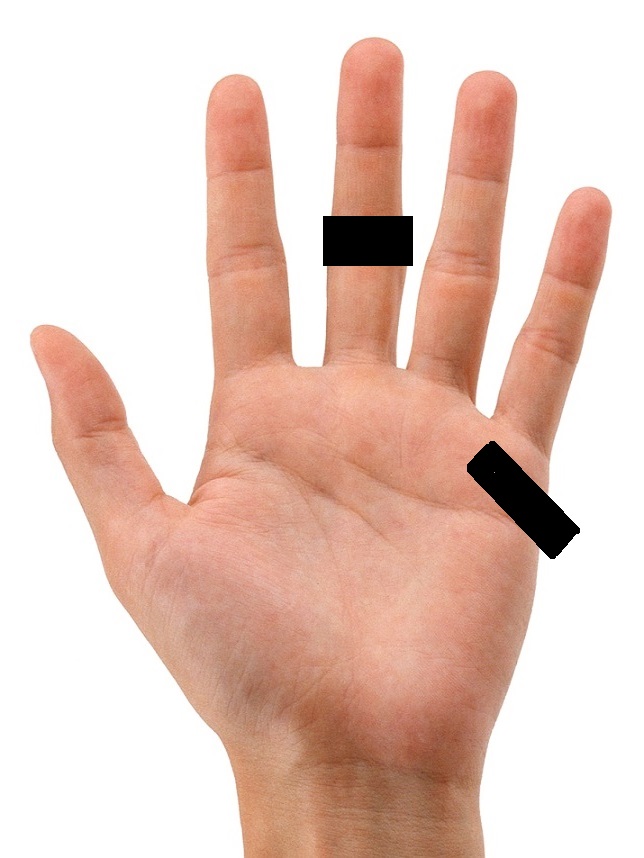
That Power Spot is the first knuckle up from the Palm. That Power Spot will be placed on the knuckle crease on the underside of the grip.
Follow the Middle Core Power Spot test with the Posterior Zone / Lower Core Power Spot shown here. That Power Spot will be placed on the 2nd Pad up from the palm on the middle finger of both hands on the underside of the grip. The Posterior Zone / Lower Core Power Spot is shown in this image. Again, that pad should be placed on the underside of the grip in both hands.
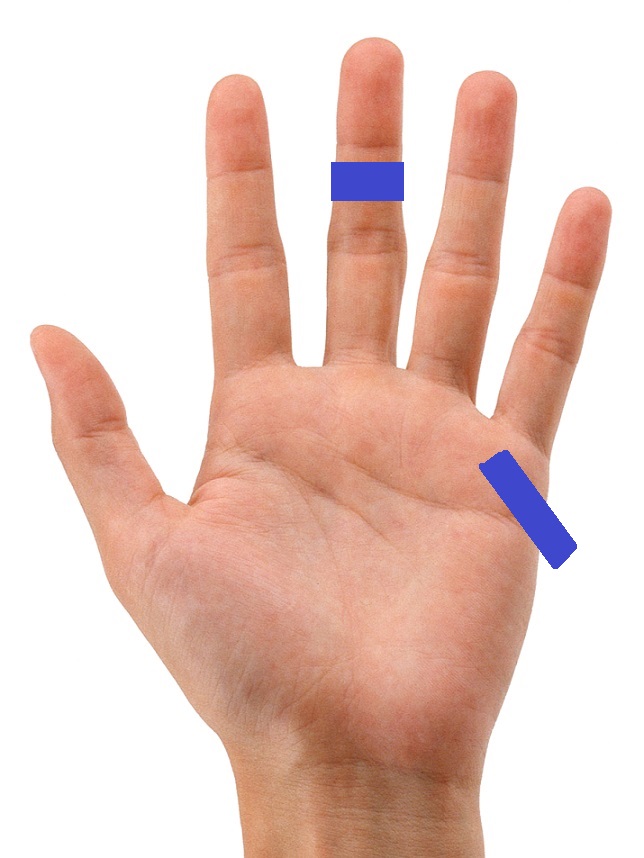
>Note: Always retest the Power Spots at the beginning of each lesson. You will find that your student has unwittingly changed their grip or made a change because they attributed subsequent poor ball striking to their grip change.
AGAIN, ALWAYS RETEST THE POWER SPOT AT EACH LESSON
I can't tell you how many times in the years past that I would get part way through a lesson, remember to test Power Spots and note that they were off, especially when ball striking was way off.


Please also remember that the performance range for your 3 Core Zones is a different range for each.
Anterior Zone / Upper Core 8-16 inches
Interior Zone / Middle Core 16-24 inches
Posterior Zone / Lower Core 20- 28 inchesNote: The above Stance Width ranges apply to all activities. For example, if your student is doing squats in the gym with or without weights, they would do the Wright Balance® Express in a Posterior Zone / Lower Core Stance Width and then do squats between 20 and 28 inches. Or, if they were cycling or running, they would do the Wright Balance® Express in an Anterior Zone / Upper Core Stance Width. Those activities naturally fit within the 8 inch Stance Range of 8 to 16 inches.
The Source of Power at the Top of the Swing
The source of Power at the top of the swing comes from the Carrying Angle. The Carrying Angle is the Angle of Range of Motion and Power through the body. The Carrying Angle is set by the Power Spots. This EBook link details the origin of the Carrying Angle and the numerous times it shows up in the golf swing.
https://instructions.wrightbalance.com/the-power-of-angles/
The following describes how the Carrying Angle creates Power at the top as a way of determining the Dominant Core Zone.
The Carrying Angle was measured in the original Wright Balance® research at Centinela Hospital as shown in this illustration.

I moved from a goniometer to a digital protractor for ease of measurement with a digital readout.

You can see from these images how Power is set when the Carrying Angle is repeated at the top of the swing...

...and repeats in the grip when the Power Spot matches the players strength.

Measure Power / Carrying Angle at Playing Core Region Stance Width. Here is the Carrying Angle being measured following the Wright Balance® Express in a Middle Core Stance Width (16 to 24 inches.

Take your students trail wrist at the top of their swing, and let left hand and arm drop with club. Hold the angle of the right arm, have student stand tall and look straight ahead.

When your student has power at the top and you test their Angle at the top as described above, that Angle is always the same as Carrying / Power Angle.

That is the source of downswing power in the golf swing. The players hip line, when tested using the Wright Balance® Downswing Club Path Test (DPT), will disclose whether their Grip, Posture, Sequence of Motion and more is correct. Testing Power at the top of the swing to determine the player Dominant Core Zone is only the beginning of Wright Balance®. Read on for more information in the Wright Balance® EBooks and Certification chapters.